
VRF Heat Recovery - Master Indoor Unit and Mode Control
1. Typical scenario
Two indoor units on a heat-recovery VRF system are connected to one wired controller using the Y1-Y2 controller network rather than individual dedicated controllers. The indoor units may also be grouped together on a central controller.
A common symptom is that the group will not change directly from HEAT to COOL while operating. The indoor units may first need to be stopped before the operating mode can be changed, and an AUTO mode may not be available from the controller.
2. How the master indoor unit affects mode
| Configuration | Expected behaviour |
|---|---|
| Master indoor specifically configured | That indoor unit becomes the reference unit for operating-mode control. |
| Shared controller with no specific master selection | The group may use the indoor unit with the lowest address as the reference/master unit. |
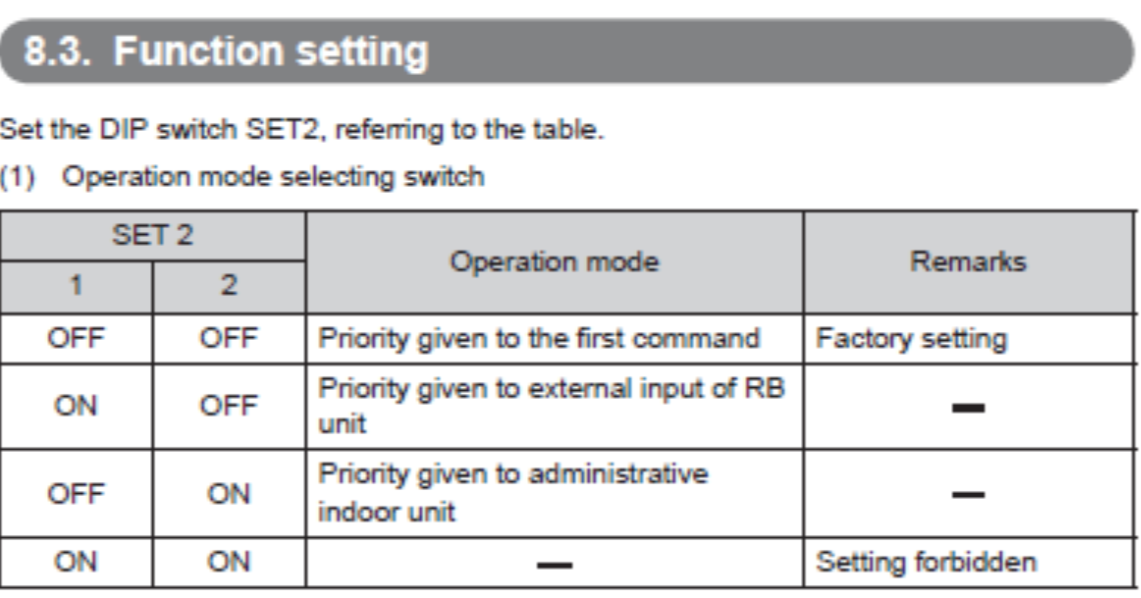
3. Heat-recovery RB unit setting
On a heat-recovery system, the refrigerant branch (RB) unit also has a configuration setting associated with master indoor operation. The relevant DIP-switch setting on the RB unit must be enabled where the installation requires a designated master indoor unit.
4. Checks when the group will not change mode
| 1 | Confirm both indoor units are intentionally configured to share the same wired controller. |
| 2 | Check the indoor-unit addresses and identify which unit has the lowest address. |
| 3 | If a specific indoor unit must control the mode, confirm that the master indoor setting has been configured correctly. |
| 4 | Confirm the RB unit DIP-switch setting required to enable master indoor operation. |
| 5 | After configuration, test whether the group can stop and then change between HEAT and COOL as expected. |
5. Summary
If two indoor units share one controller on a heat-recovery system, mode selection is controlled by the master/reference indoor unit. A master indoor can be configured, and the RB unit includes a DIP-switch setting to enable this function. If no specific master is selected, the shared controller group may default to the indoor unit with the lowest address.