
RTPU Dual-Stage Defrost Operation
Application
| Category | Technical Support |
| Product | Rooftop Package Unit / RTPU |
| Region | New Zealand / Low ambient applications |
| Keywords | RTPU, defrost, dual stage, heat pump, low ambient, New Zealand, MCXSimulator, L2 password, d17 |
Question
On a dual-stage rooftop package unit, if both stages are operating in heating and one stage enters defrost, what happens to the other stage?
Does the other stage continue operating in heating?
Answer
For dual-stage rooftop package units, the default behaviour may allow the other circuit/stage to continue operating in heating while one circuit is in defrost.
In very low ambient conditions, such as New Zealand applications, this behaviour may need to be adjusted using the defrost parameter setting.
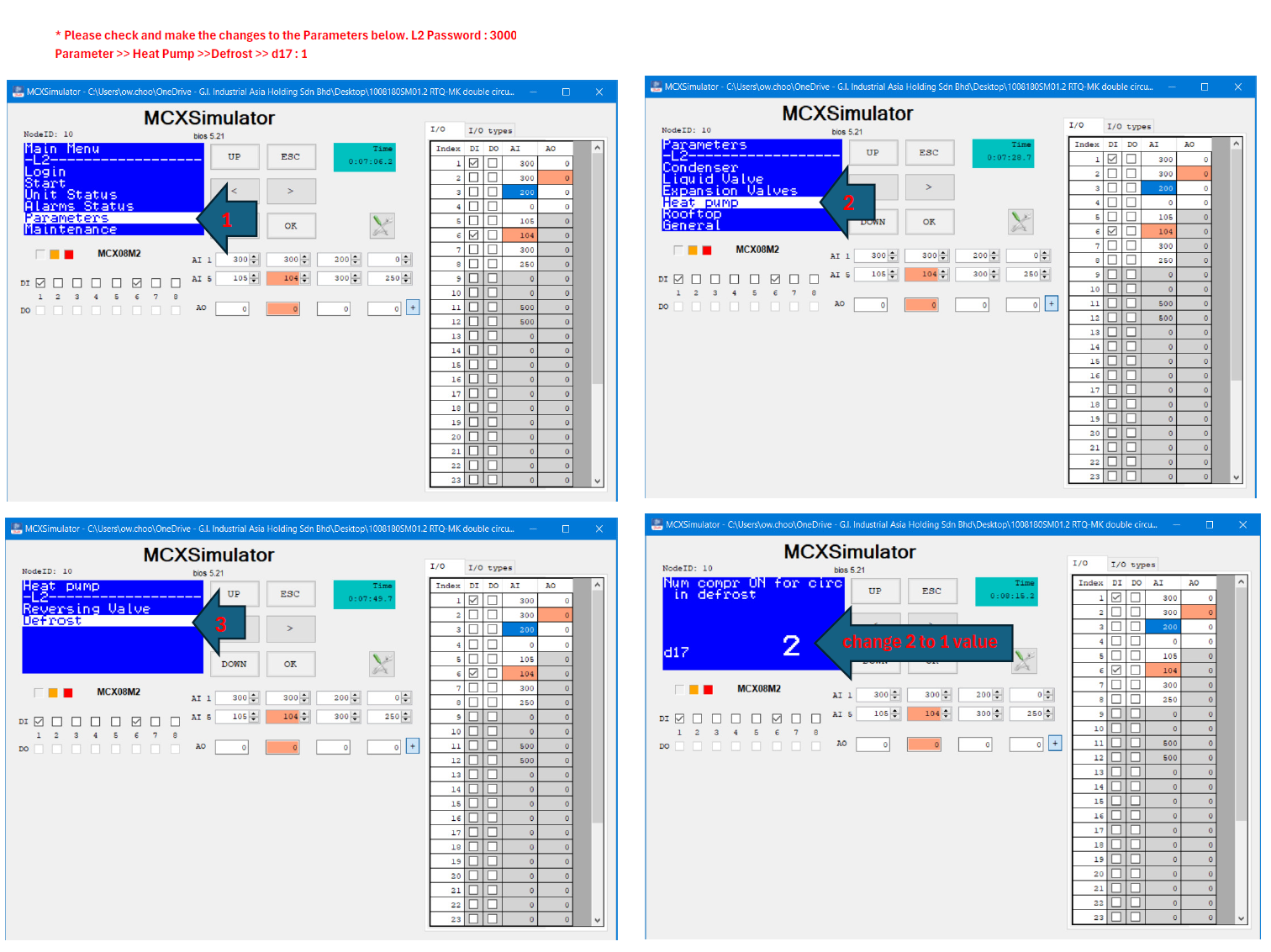
To prevent the other compressor/circuit from continuing normal heating operation while one circuit is in defrost, check and update the following parameter:
Parameters > Heat Pump > Defrost > d17
Required access level:
Level 2 password: 3000
Required setting:
Change d17 from 2 to 1.
When to Apply This Setting
This parameter should be checked during normal maintenance, especially for units installed in low ambient temperature regions such as New Zealand.
Apply this setting where there are concerns about defrost performance or where dual-stage defrost operation requires the non-defrosting circuit to be managed differently.
Procedure
- Access the controller or MCXSimulator.
- Enter the required access level using the Level 2 password: 3000.
- Navigate to Parameters > Heat Pump > Defrost.
- Locate parameter d17.
- Check the current value.
- If the value is set to 2, change it to 1.
- Confirm and save the change.
- Verify unit operation during heating and defrost conditions.
Parameter Detail
| Item | Detail |
|---|---|
| Parameter | d17 |
| Description | Number of compressors ON for circuit in defrost |
| Default / observed value | 2 |
| Recommended low ambient value | 1 |
Notes
- This change is generally required for very low ambient temperature applications, such as New Zealand.
- The parameter should be checked as part of routine service or maintenance.
- Ensure the change is performed only by authorised service personnel with the required access level.
- Confirm correct unit operation after changing the parameter.