
Multi-Head Port Connection Order
1. Issue summary
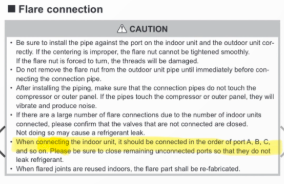
The installation manual requirement for multi-head port connection order appears in the Flare connection section and can be missed during installation.
Where pipework is connected to ports B and C with no indoor unit connected to port A, the system may still operate but can exhibit reduced capacity and a compressor that does not ramp correctly, particularly when only one indoor unit is operating.
This condition has been observed in multiple field cases and may present as a general installation or capacity complaint rather than a hard fault code.
2. Typical symptoms
- Poor heating or cooling performance compared with expected capacity.
- Compressor does not ramp up appropriately under load.
- System feels “lazy” or underpowered when only one indoor unit is operating.
- No obvious fault code; complaint may initially appear to be capacity, refrigerant or installation related.
3. Root cause
On these multi-head systems, the outdoor flare ports are not interchangeable. Indoor units must be connected in port order, typically:
Any remaining unused ports must be correctly capped and closed. When the first connected indoor unit is not on port A, system control can behave abnormally and limit performance.
4. Confirmation and diagnostic checks
Check 1 - Confirm port usage
- Visually identify which outdoor flare ports are in use: A, B, C and D where applicable.
- Confirm that an indoor unit is connected to port A.
- Confirm all unused ports are properly capped and closed.
Check 2 - Confirm indoor capacities and locations
A reported example involved a 24-class lounge unit and 09-class bedroom unit connected to B and C, with A unused. The system would not ramp correctly when only one indoor unit was operating.
Check 3 - Validate performance
If port order is incorrect, the strongest confirmation is to correct the pipe connections and re-test the system with a single indoor unit operating at high demand.
5. Corrective action
- Recover the refrigerant in accordance with policy and regulations.
- Reconnect the pipework so the first indoor unit is on port A, then the next on B, then C and D as required.
- Ensure all unused ports are properly sealed and closed.
- Evacuate, leak test and recharge in accordance with the installation requirements.
- Recommission the system and verify correct operation and performance.
6. Verification after correction
With one indoor unit operating at high demand, confirm the following:
| Check | Expected result |
|---|---|
| Compressor operation | Compressor ramps appropriately as demand increases. |
| Capacity | Supply-air temperature and delivered capacity align with expected performance. |
| Cycling | No abnormal cycling or sustained low-output behaviour. |
7. Prevention and installer guidance
- During installation briefings, call out that the port-order requirement is located in the Flare connection section of the installation manual.
- Add the following check to commissioning documentation: “Confirm multi-head indoor connections are in A → B → C order and confirm all unused ports are closed.”