
General Assist Technical Reference
AOTH30KBTA - Abnormal Vibration and Noise
Discharge pipe butyl rubber contacting dividing panel
Factory investigation and field corrective action
Applies to: AOTH30KBTA (T002472)
Known production example: 8 April 2024 - use the unit serial number and production date to confirm applicability.
Last updated: 19 December 2025
Source: Factory investigation (FG Thailand) - Kono
Known production example: 8 April 2024 - use the unit serial number and production date to confirm applicability.
Last updated: 19 December 2025
Source: Factory investigation (FG Thailand) - Kono
Key finding: Abnormal vibration or resonant cabinet noise can occur if butyl rubber adhered to the discharge pipe contacts the dividing panel. The corrective action is to restore clearance without introducing stress into the refrigerant piping.
1. Issue summary
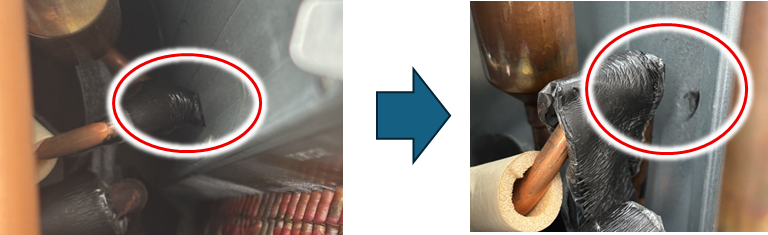
Some outdoor units may present abnormal vibration and noise when butyl rubber adhered to the discharge pipe makes contact with the dividing panel. This can create resonance and transmit vibration into the cabinet.
2. Symptoms
- Outdoor unit produces abnormal vibration, rattle or resonant noise.
- Noise may be intermittent or worsen under load, including when the compressor is operating or discharge temperature increases.
- Noise may reduce or stop when hand pressure is applied to the cabinet or when the pipe position shifts slightly.
3. Root cause
- Butyl rubber protrusion or bonding position on the discharge pipe can reduce clearance.
- If the discharge pipe and butyl rubber contact the dividing panel, vibration can be transmitted into the cabinet and result in abnormal noise.
Factory note: Workers were instructed on the bonding procedure, however historically there was no downstream inspection specifically focused on butyl rubber protrusion reducing the required clearance.
4. Inspection and diagnosis
| 1 | Confirm the symptom with the unit operating, where safe and appropriate. |
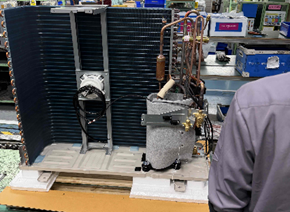
| 2 | Remove panels as required and visually inspect the discharge pipe area. Look for butyl rubber contacting, or positioned very close to, the dividing panel. |
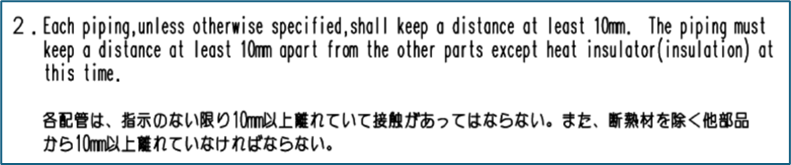
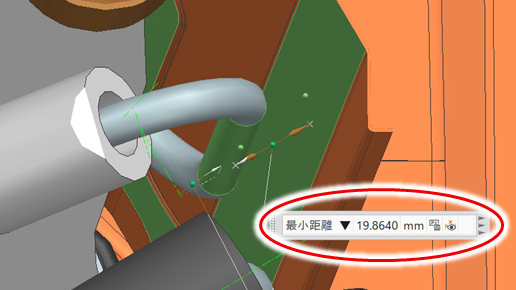
| 3 | Check clearance: minimum required clearance is 10 mm between the piping/butyl rubber and dividing panel. This model is typically designed with approximately 20 mm clearance, so a unit near 10 mm may be more susceptible. |
| 4 | If rub marks or witness marks are present on the panel or butyl rubber, treat the contact condition as confirmed. |
5. Resolution - field fix
Corrective action: Move or reposition the discharge pipe so the butyl rubber is separated from the dividing panel.
Acceptance criteria after adjustment
| Check | Required condition |
|---|---|
| Clearance | Butyl rubber on the discharge pipe is at least 10 mm clear of the dividing panel. |
| Butyl adhesion | Butyl rubber is pressed firmly with no gaps. |
| Bonding position | Butyl rubber is correctly positioned and does not protrude into the panel clearance zone. |
| Operation | Abnormal vibration/noise stops and unit operation returns to normal. |
Important: Do not create strain on brazed joints or introduce pipe stress. Any repositioning must maintain safe pipe routing and support.
6. Factory preventative action
For production from 9 December 2025, factory instructed operators to confirm the following during the first visual inspection:
- Clearance of 10 mm or greater between butyl rubber on the discharge pipe and the dividing panel.
- Butyl rubber fully pressed with no gaps.
- Correct bonding position.
The countermeasure is also to be applied to other chassis where a similar part-contact noise risk exists.
7. Mandatory ticket information
When logging or escalating this issue, capture:
- Model: AOTH30KBTA (T002472).
- Serial number and production date, preferably with a photo of the nameplate.
- Short video/audio recording of the noise, before and after adjustment where possible.
- Photos showing butyl rubber placement on the discharge pipe.
- Photo showing clearance to the dividing panel, with a measurement visible where possible.
- Any rub marks or witness marks at the contact point.
- Confirmation that final clearance is 10 mm or greater after adjustment.
- Outcome: noise eliminated, reduced or unchanged.
General Assist Technical Reference - AOTH30KBTA abnormal vibration/noise investigation.