
VRF Preventative Maintenance Guidelines
The purpose of this guideline is to minimise incidental failures, prolong the service life of VRF systems and reduce operating costs. Proper maintenance helps maintain performance and reliability in commercial applications such as hotels and offices.
The maintenance periods below follow the periodic inspection recommendations referenced in the source material from JRAIA (Japan Refrigeration and Air Conditioning Industry Association) and Fujitsu General maintenance schedules.
Important: Replacement and repair periods are averages only. They do not represent the guaranteed life of the product or component.
Maintenance Frequency
- Quarterly Maintenance: Basic inspections and cleaning.
- Annual Maintenance: More thorough inspection, preferably before peak summer or winter operation.
- Component-Specific Maintenance: Based on the component service period and accumulated operating hours.
Outdoor Unit Maintenance
| Component | Inspection Frequency | Replacement / Repair Period | Inspection Method | Maintenance Action |
|---|---|---|---|---|
| Cabinet / Panel / Guard | Once a year | Cleaning: 8 years | Visual inspection | Cleaning, touch-up paint |
| Vibration Rubber | Annually | Parts change: 10 years | Visual, sound check | Parts replacement |
| Fan / Fan Guard | Annually | Parts change: 10 years | Visual, sound check | Parts replacement |
| Fan Motor | Annually | Parts change: 20,000 hours | Insulation resistance test | Replacement if necessary |
| Compressor | Annually | Parts change: 20,000 hours | Sound, vibration check | Replacement if needed |
| Heat Exchanger | Annually | Cleaning: 5 years | Visual inspection | Cleaning |
| Pipes | Annually | Parts change: 20,000 hours | Leak detection | Replacement if necessary |
| Refrigerant Valves (4-way / Expansion) | Annually | Parts change: 20,000 hours | Leak check, function test | Replacement if needed |
| Protective Devices (Pressure switch / Capacitors) | Annually | Parts change: 25,000 hours | Voltage check | Replacement if necessary |
| Electrical Components | Annually | Parts change: 25,000 hours | Resistance test | Replacement |
| Condenser Coil | Quarterly | Cleaning | Visual inspection | Cleaning |
Indoor Unit Maintenance
| Component | Inspection Frequency | Replacement / Repair Period | Inspection Method | Maintenance Action |
|---|---|---|---|---|
| Decoration Panel | Once a year | Cleaning: 8 years | Visual inspection | Cleaning |
| Air Filters | Monthly | Cleaning: Weekly; Change: 5 years | Visual inspection | Cleaning, replacement |
| Fan & Fan Casing | Annually | Parts change: 13 years | Sound check | Replacement if needed |
| Drain Pan | Annually | Parts change: 8 years | Visual inspection | Cleaning, replacement |
| Drain Pump | Annually | Parts change: 20,000 hours | Functional test | Replacement if needed |
| Heat Exchanger | Annually | Cleaning: 5 years | Visual inspection | Cleaning |
| Pipes | Annually | Parts change: 20,000 hours | Leak detection | Replacement if necessary |
| Temperature Sensor | Annually | Parts change: 5 years | Resistance test | Replacement |
| Remote Controller | Annually | Parts change: 25,000 hours | Function test | Replacement if needed |
General Inspection Procedures
- Electrical System: Check voltage, terminal connections and insulation resistance. The source specifies greater than 1 MΩ.
- Refrigerant System: Inspect refrigerant condition, leaks and pressure readings.
- Drainage System: Confirm correct drainage and check for restrictions or blockages.
- Noise & Vibration: Investigate abnormal sounds or excessive vibration.
- Coils & Heat Exchangers: Inspect for dirt accumulation and corrosion; clean as required.
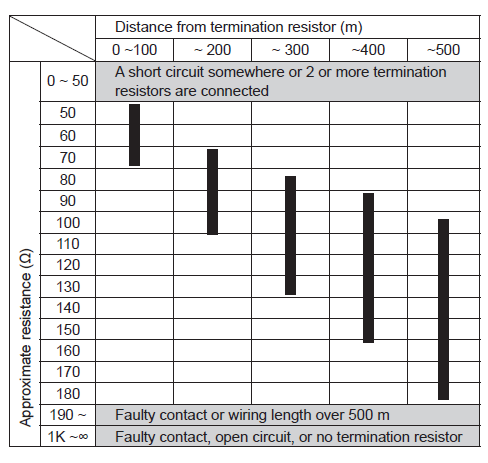
- Transmission Wiring: Measure resistance between the signal amplifier terminal and the furthest connected indoor/outdoor unit terminal where the terminal resistor is measured.
Transmission resistance: The resistance between transmission cable terminals is stated as approximately 45-60 Ω. This is an estimated value and may vary depending on cable distance and where the terminal resistor is installed.
Checking Air On and Air Off Temperatures
- Measure the air temperature entering the evaporator coil (Air On).
- Measure the air temperature leaving the evaporator coil (Air Off).
- Compare the temperature difference (Delta T) with the applicable manufacturer specification.
- Confirm adequate airflow and that the system is cooling or heating effectively.
- Investigate abnormal temperature differences that may indicate refrigerant issues, airflow restrictions or component faults.
Special Maintenance Considerations
- Harsh Environments: Increase maintenance frequency where there is excessive dust, humidity or corrosive contamination.
- Power Quality: Check for voltage fluctuations, phase imbalance and power surges.
- Operating Hours: Systems operating more than 10 hours per day may require earlier component replacement.
- Restarting After a Long Shutdown: Leave the breaker ON for at least 12 hours before restarting operation after an extended power-off period.