
General Assist Information Guide
How to Calculate Air Conditioner Energy Consumption
Estimate your daily and monthly air conditioning running costs
Use the unit's electrical input, operating time and electricity tariff to calculate an indicative cost.
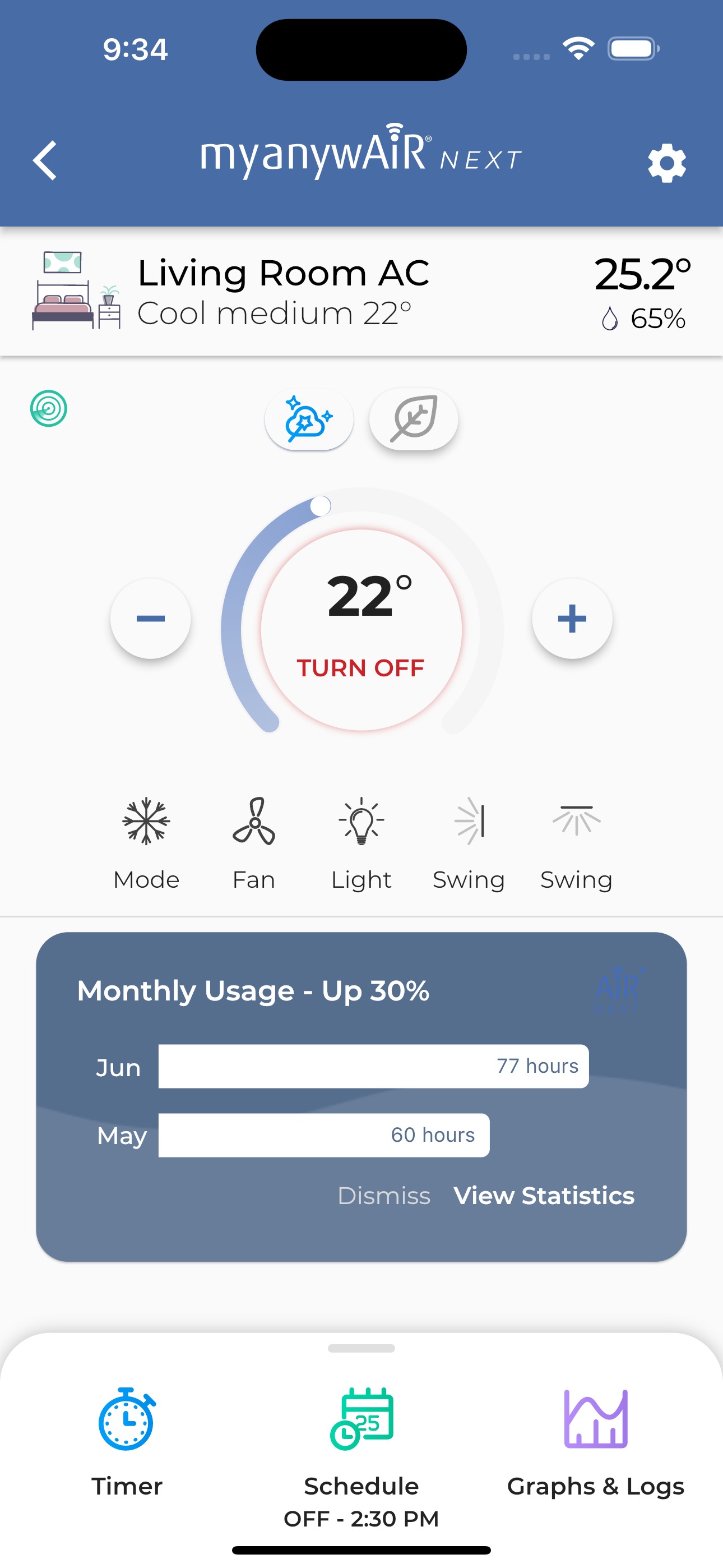
Understanding your monthly air conditioner usage can help you estimate electricity consumption and identify opportunities to manage running costs.
1. Information you will need
| Information | Where to find it |
|---|---|
| Electrical input in watts (W) or kilowatts (kW) | The product specification, energy label, technical data sheet or unit rating information. |
| Daily operating time | The approximate number of hours the air conditioner operates each day. |
| Electricity tariff | Your electricity bill, expressed as dollars or cents per kilowatt-hour (kWh). |
Important: Use the unit's electrical input, not its advertised cooling or heating capacity. A unit described as 5.0 kW cooling capacity does not necessarily consume 5.0 kW of electricity.
2. Calculate energy consumption
Step 1 - Convert watts to kilowatts
Watts ÷ 1,000 = kilowatts
Step 2 - Calculate daily energy use
Electrical input (kW) × operating hours = daily energy consumption (kWh)
Step 3 - Calculate the running cost
Energy consumption (kWh) × electricity tariff ($/kWh) = electricity cost
3. Worked example
The following example uses an air conditioner with an electrical input of 300 W, operating for 4 hours per day, at an electricity tariff of $0.30 per kWh.
| Calculation | Result |
|---|---|
| 300 W ÷ 1,000 | 0.3 kW |
| 0.3 kW × 4 hours | 1.2 kWh per day |
| 1.2 kWh × 30 days | 36 kWh per month |
| 36 kWh × $0.30 per kWh | $10.80 per month |
4. Important notes
- The calculation provides an estimate only. Actual consumption will vary with the model, selected mode, set temperature, fan speed, outdoor temperature, room heat load, insulation and maintenance condition.
- Inverter air conditioners vary their electrical input during operation. They do not normally consume their rated input continuously.
- Single-room air conditioners can have substantially different electrical inputs depending on their capacity and operating conditions.
- Whole-home or central systems generally consume more electricity than individual room systems because they condition a larger area.
- Daily supply charges, demand charges and time-of-use tariff differences are not included in this calculation.
- For the most accurate measurement, use a compatible energy monitoring device or review interval data supplied by your electricity retailer.
Quick formula:
Electrical input (kW) × hours used × number of days × electricity tariff ($/kWh) = estimated running cost.
Electrical input (kW) × hours used × number of days × electricity tariff ($/kWh) = estimated running cost.