
General Assist Technical Reference
Compressor Resistance and Insulation Testing
Winding balance, insulation integrity and inverter compressor speed checks
Technical guidance for qualified refrigeration and air-conditioning service personnel
The compressor pressurises refrigerant within the refrigeration cycle. Resistance and insulation testing verifies winding balance, electrical integrity and supports diagnosis of non-start or trip conditions.
High voltage and pressure hazard: Isolate power, discharge capacitors and confirm the circuit is de-energised before testing. Never perform resistance or insulation measurements on a live circuit.
Overview
The compressor is the core component responsible for pressurising refrigerant within the refrigeration cycle. Accurate resistance and insulation testing helps verify the electrical integrity and mechanical health of the compressor motor windings.
This procedure verifies winding balance and insulation condition, and supports fault diagnosis for non-start or trip conditions.
1. Testing Conditions
- Power must be OFF.
- Use a digital multimeter in resistance mode and a megohmmeter for insulation testing.
- Perform testing at an ambient temperature of 20-25°C for accurate readings.
- Disconnect the compressor terminals before taking measurements.
2. Test Procedure
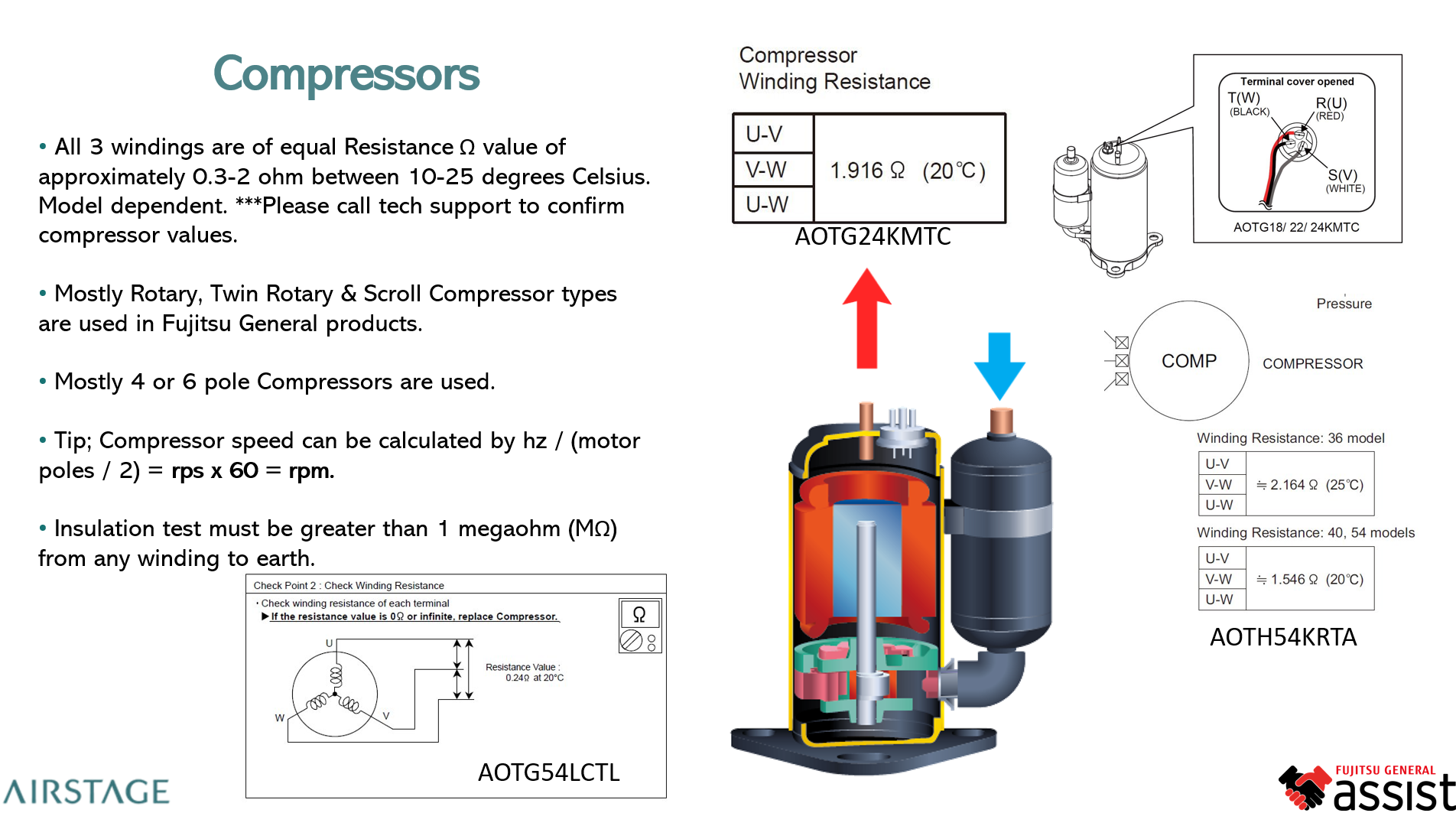
2.1 Winding Resistance Test
- Disconnect the compressor terminals.
- Identify the winding terminals:
- U - Red
- V - White
- W - Black
- Measure resistance between each terminal pair: U-V, V-W and U-W.
Expected result: Resistance should be equal across all three terminal pairs. Typical values are 0.3 Ω to 2.0 Ω, depending on model and temperature.
| Example Model | Reference Resistance | Reference Temperature |
|---|---|---|
| AOTG24KMTC | 1.916 Ω | 20°C |
| AOTH54KRTA | 1.546 Ω | 20°C |
| AOTH36 model | 2.164 Ω | 25°C |
Important: A reading of 0 Ω indicates a short circuit. A reading of O/L indicates an open circuit. The source procedure specifies compressor replacement in either condition.
2.2 Insulation Resistance Test
- Using a megohmmeter at 500 V DC, measure between each compressor terminal and the compressor body (earth).
- The minimum expected insulation resistance is greater than 1 MΩ, with greater than 10 MΩ preferred.
Low insulation resistance: A value below 1 MΩ may indicate moisture ingress or winding breakdown. The source procedure specifies compressor replacement.
2.3 Inverter Compressor Speed Calculation
Approximate compressor speed can be calculated using:
Compressor speed (rpm) = Frequency (Hz) ÷ (Motor poles ÷ 2) × 60
Example: For a 4-pole compressor operating at 90 Hz:
90 ÷ (4 ÷ 2) × 60 = 2700 rpm
3. Diagnosis and Interpretation
| Observation | Diagnosis | Recommended Action |
|---|---|---|
| Equal winding resistance | Compressor windings normal | No fault detected |
| Open circuit (O/L) | Broken winding | Replace compressor |
| Short circuit (0 Ω) | Internal winding short | Replace compressor |
| Unequal winding values | Partial short or imbalance | Replace compressor |
| Insulation below 1 MΩ | Breakdown or moisture ingress | Replace compressor |
| Normal winding and insulation values | Proceed with inverter/IPM checks | Verify system controls |
4. Technical Notes
- Ensure compressor terminals are clean and dry before testing.
- Do not apply voltage to the compressor before confirming correct winding and insulation values.
- Compressors used in Fujitsu General systems are primarily rotary, twin rotary or scroll type, typically with 4 or 6 poles.
- Always confirm the expected values for the specific model with Fujitsu Technical Support.
This information is intended for qualified service personnel. Confirm model-specific values and procedures before component replacement.