
Technical Service Reference
DC Brushless Fan Motor Testing
Electrical integrity, mechanical inspection and feedback verification
Use this procedure to assess a high-voltage DC fan motor and identify electrical, mechanical or feedback-related faults.
Overview
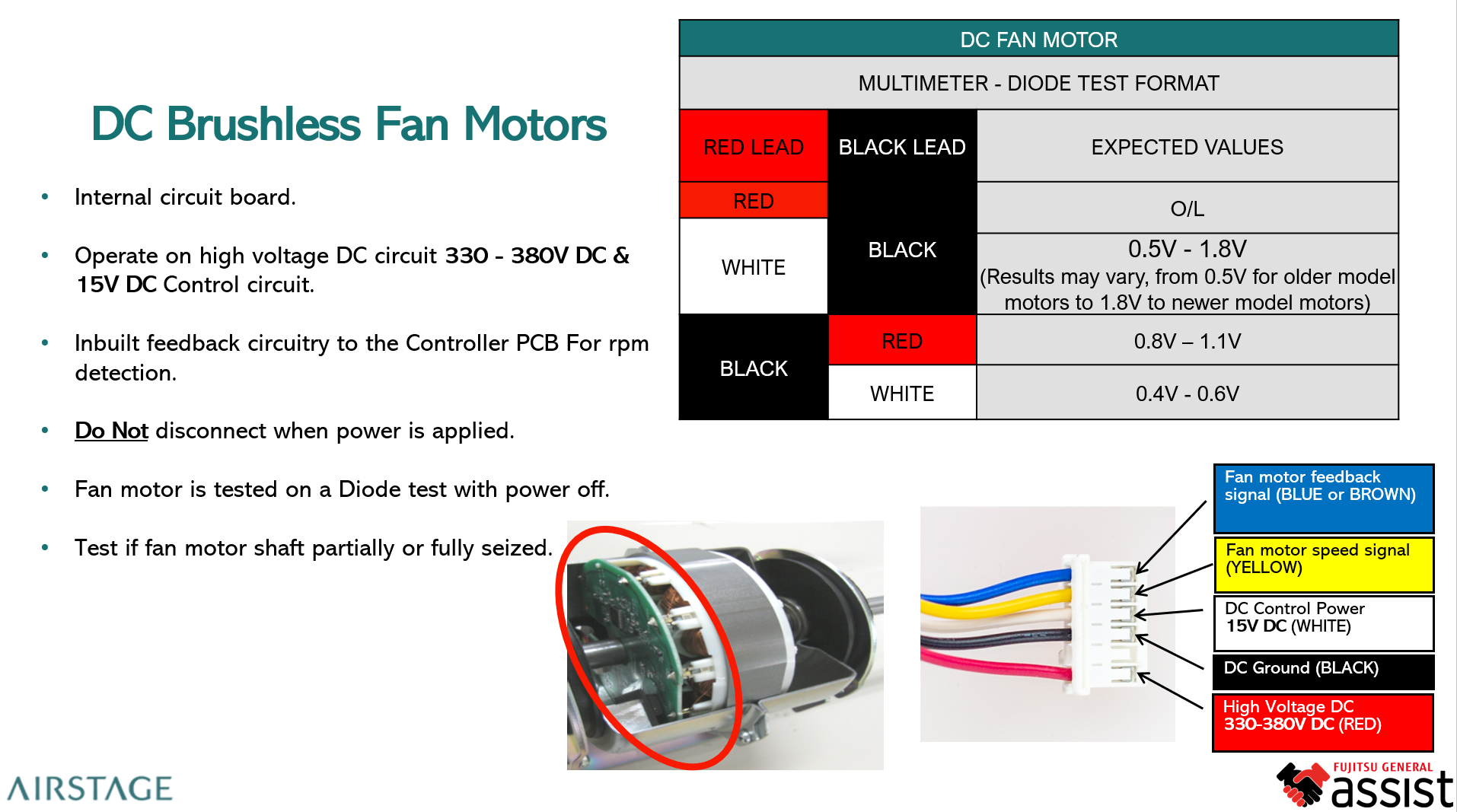
The DC brushless fan motor operates using a high-voltage DC circuit of 330–380V DC and a 15V DC control circuit. An integrated control board provides fan-speed feedback to the main controller PCB. This procedure checks the motor's electrical integrity and identifies mechanical obstruction or failure.
The DC brushless fan motor operates using a high-voltage DC circuit of 330–380V DC and a 15V DC control circuit. An integrated control board provides fan-speed feedback to the main controller PCB. This procedure checks the motor's electrical integrity and identifies mechanical obstruction or failure.
High-voltage hazard
The fan motor contains high-voltage DC circuitry. Do not disconnect or handle wiring while power is applied. Isolate power and allow the circuit to discharge fully before testing.
The fan motor contains high-voltage DC circuitry. Do not disconnect or handle wiring while power is applied. Isolate power and allow the circuit to discharge fully before testing.
1. Testing conditions
- Ensure power is OFF and the circuit is fully discharged.
- Use a digital multimeter set to Diode Test Mode.
- Visually inspect the fan and confirm the shaft can rotate freely.
2. Identify the fan motor connector
Locate the fan motor connector and identify the terminals before taking measurements.
| Wire colour | Function |
|---|---|
| Red | High-voltage DC supply, 330–380V DC |
| White | DC control power, 15V DC |
| Black | DC ground |
| Yellow | Fan-speed signal |
| Blue or brown | Feedback signal |
3. Electrical test — power off
With the multimeter in Diode Test Mode, position the meter leads as shown and compare the measured voltage drop with the expected value.
| Red meter lead | Black meter lead | Expected reading |
|---|---|---|
| Red terminal | Black terminal | O/L |
| Red terminal | White terminal | 0.5V–1.8V, depending on motor age |
| Black terminal | Red terminal | 0.8V–1.1V |
| Black terminal | White terminal | 0.4V–0.6V |
Reading variation: Older motors may read approximately 0.5V between the red and white terminals, while newer motors may read up to 1.8V.
4. Mechanical and feedback checks
Mechanical test
- Manually rotate the fan blade.
- Confirm the blade rotates smoothly and freely.
- Stiffness, grinding or uneven movement indicates possible bearing or shaft seizure.
Feedback verification
- Confirm the blue or brown feedback wire is correctly connected to the control PCB.
- A faulty feedback circuit may cause fan-speed error codes or abnormal operation.
5. Diagnosis and interpretation
| Observation | Likely diagnosis | Action |
|---|---|---|
| Readings match the expected values | Motor circuit normal | No motor fault detected |
| Infinite resistance or 0V across all tests | Open or shorted motor circuit | Replace the motor |
| Shaft seized or restricted | Mechanical fault | Replace the fan motor assembly |
| No RPM feedback | Feedback signal open or defective PCB | Check wiring, then replace the fan motor or controller PCB as required |
6. Technical notes
- The fan motor's internal PCB regulates rotation speed using PWM control and provides tachometer feedback to the indoor-unit controller.
- During operation, the fan receives 330–380V DC for power and 15V DC for control.
- Disconnecting the motor while energised can damage both the motor and the control PCB.
This information is intended for qualified service personnel. Always follow the applicable service manual, electrical safety procedures and local requirements.