
AIRSTAGE Technical Reference
Pressure Transducer Sensor Testing
Live voltage, diode testing and fault diagnosis
For outdoor-unit refrigerant pressure sensors used in heating and cooling systems
The pressure transducer converts refrigerant pressure into a proportional DC voltage signal. The outdoor control PCB uses this signal to manage compressor frequency, expansion valve operation and system protection.
Safety: Live testing must only be completed by suitably qualified personnel. Isolate power before unplugging the sensor or performing diode checks, and allow capacitors to discharge fully.
1. Function overview
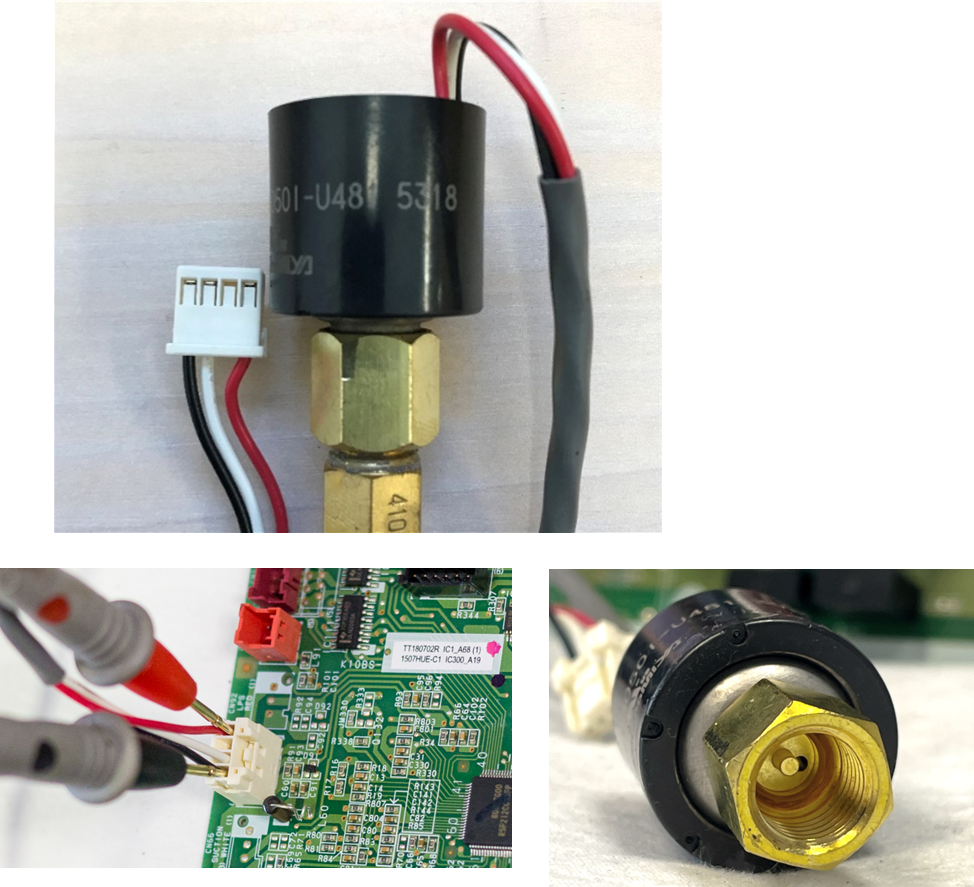
- The sensor receives a 5 V DC reference supply from the outdoor control PCB.
- It returns a variable 0.5-4.5 V DC signal proportional to refrigerant pressure.
- The sensing element uses a semiconductor diaphragm and strain gauge that changes resistance as pressure changes.
| Terminal colour | Function |
|---|---|
| Red | +5 V DC supply from PCB |
| Black | Ground (0 V) |
| White | Signal return / pressure output |
2. Power-on test
Objective: Confirm the correct sensor supply voltage and pressure-dependent output signal.
- Power on the outdoor unit and allow the system to operate for several minutes.
- Set the multimeter to DC voltage.
- Measure between the red wire and black wire. Confirm approximately 5.0 V DC.
- Measure between the white wire and black wire. Record the signal voltage.
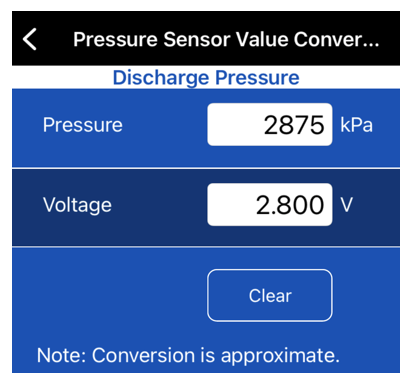
- Compare the voltage with the corresponding refrigerant pressure using the reference chart or the M Technician App.
| Measured voltage | Approx. pressure |
|---|---|
| 0.5 V | 0 kPa - vacuum / low pressure |
| 1.0 V | 700 kPa |
| 1.5 V | 1400 kPa |
| 2.0 V | 2100 kPa |
| 2.5 V | 2700 kPa |
| 2.8 V | 2875 kPa |
| 3.0 V | 3000 kPa |
| 4.0 V | 4200 kPa |
| 4.5 V | 5000 kPa - high pressure cut |
Measurement tip: Use the sensor's black ground wire as the reference point for all live voltage measurements.
Example: A 2.8 V DC return signal corresponds to approximately 2875 kPa.
3. Power-off diode test
Objective: Verify the internal sensor circuit and identify short, open or earth faults.
- Turn off system power and ensure all capacitors have discharged.
- Unplug the transducer connector from the PCB.
- Set the multimeter to diode mode.
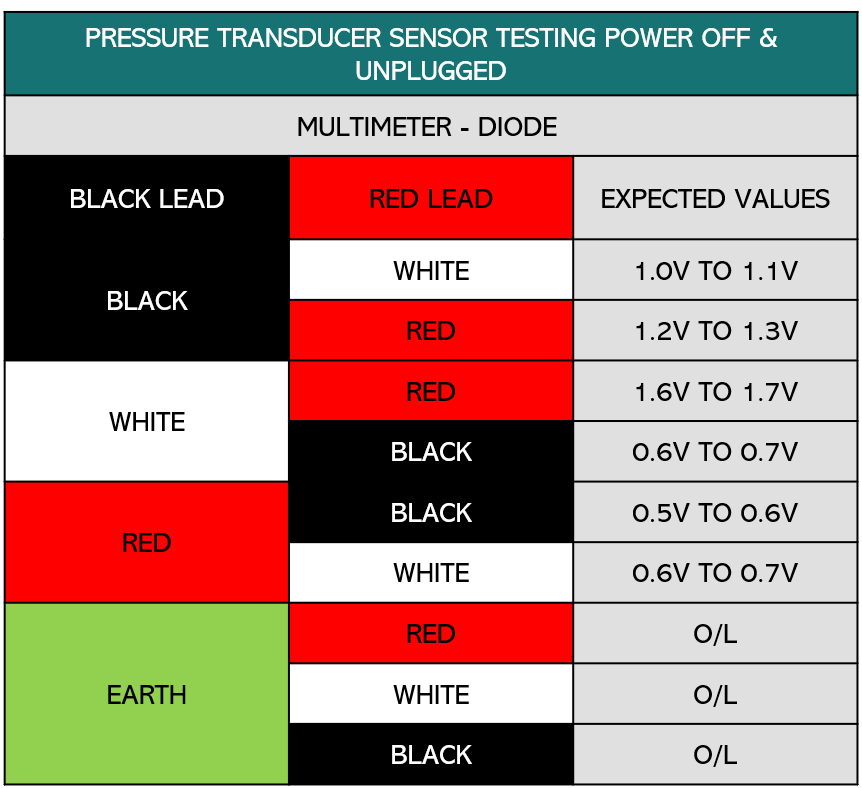
- Measure each terminal combination shown below.
| Multimeter leads | Expected reading |
|---|---|
| Black to White | 1.0-1.1 V |
| Black to Red | 1.2-1.3 V |
| White to Red | 1.6-1.7 V |
| Red to Black | 0.6-0.7 V |
| White to Black | 0.5-0.6 V |
| Red to White | 0.6-0.7 V |
| Earth to any lead | O/L |
Interpretation
- All readings within range: sensor condition is normal.
- O/L between signal and supply: possible open circuit.
- Very low reading below 0.3 V: possible internal short or moisture intrusion.
- Continuity to earth: ground fault; replace the sensor.
4. Fault diagnosis
| Symptom | Possible cause | Service action |
|---|---|---|
| No voltage output | Open circuit or disconnected plug | Check connector and harness continuity |
| Fixed at 0.5 V or 5 V | Internal sensor failure | Replace sensor |
| Unstable or fluctuating voltage | Loose terminal or moisture | Clean, dry and reseat connector |
| Incorrect voltage-pressure relationship | Calibration drift or sensor wear | Replace pressure sensor |
| Discharge or suction sensor error | PCB detects short or open circuit | Confirm with live and diode tests, then replace as required |
5. Service notes
- Normal signal range is 0.5-4.5 V DC.
- A reading below 0.5 V may indicate vacuum or no pressure. A reading above 4.5 V may indicate an overpressure condition.
- Test only under stable running conditions. Start-up and defrost readings may be transient and unsuitable for diagnosis.
- Do not megger test the pressure transducer. High insulation-test voltage can damage the sensing element.
6. Summary
- Supply: 5.0 V DC between red and black.
- Signal: 0.5-4.5 V DC between white and black, proportional to refrigerant pressure.
- Power-off test: Diode readings confirm internal circuit integrity.
- Reference: Compare voltage and pressure using the M Technician App.