Electronic Expansion Valve (EEV) Coil Testing
Description
Electronic Expansion Valves (EEVs) regulate refrigerant flow through the system by using a stepper motor controlled via precise voltage pulses.
The EEV coil converts electrical signals from the outdoor PCB into linear or rotary motion to adjust valve position, ensuring efficient system performance during cooling, heating, and defrost operations.
Testing the EEV coil verifies electrical continuity and insulation integrity to confirm proper actuator function.
1. Test Objective
To measure the coil resistance of the EEV actuator and confirm it falls within the manufacturer’s specification.
Incorrect resistance readings indicate a damaged coil, shorted winding, or open circuit condition.
2. Tools Required
- Digital multimeter (minimum 0.1 Ω accuracy)
- Insulated test probes
- Manufacturer’s coil resistance chart
- Inspection torch and dielectric grease (for terminal corrosion prevention)
3. Inspection Before Testing
Before electrical measurement:
- Visually inspect coil harness and connector pins for corrosion, oxidation, or moisture intrusion.
- Ensure the coil is firmly clipped to the EEV body for effective magnetic coupling.
- Verify that the EEV wiring harness is free from cuts or insulation damage.
4. Coil Testing – Resistance Method
Step 1 – Isolate Power
Disconnect system power supply and allow capacitors to discharge fully.
Unplug the EEV connector from the PCB before measurement.
Step 2 – Multimeter Setup
Set the digital multimeter to the Ω (resistance) range.
Step 3 – Measure and Record Readings
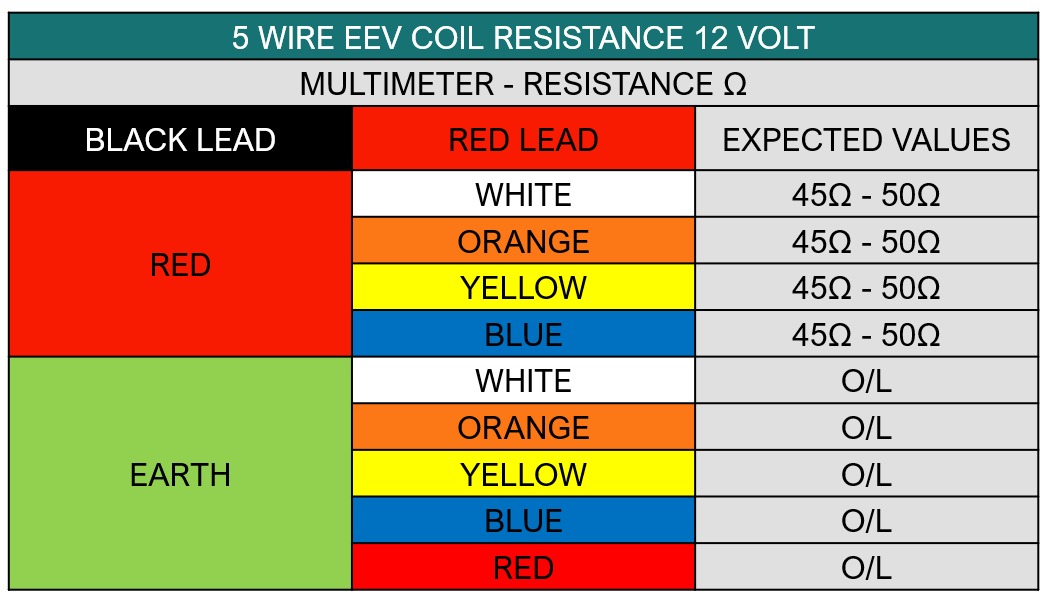
(a) 5-Wire Coil – 12 V Type
| Test Leads | Expected Reading (Ω) | Remarks |
|---|---|---|
| Red → White | 45 – 50 Ω | Normal range |
| Red → Orange | 45 – 50 Ω | Normal range |
| Red → Yellow | 45 – 50 Ω | Normal range |
| Red → Blue | 45 – 50 Ω | Normal range |
| Earth → All other leads | O/L | No continuity to ground |
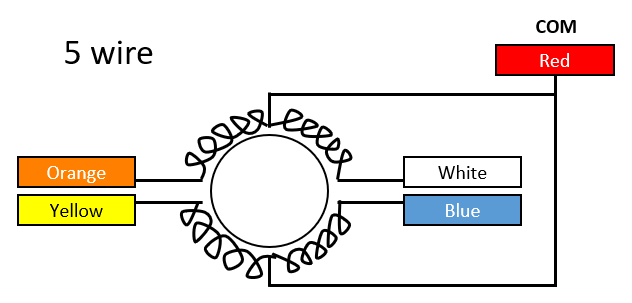
Coil identification: Red = common; remaining four are individual windings.
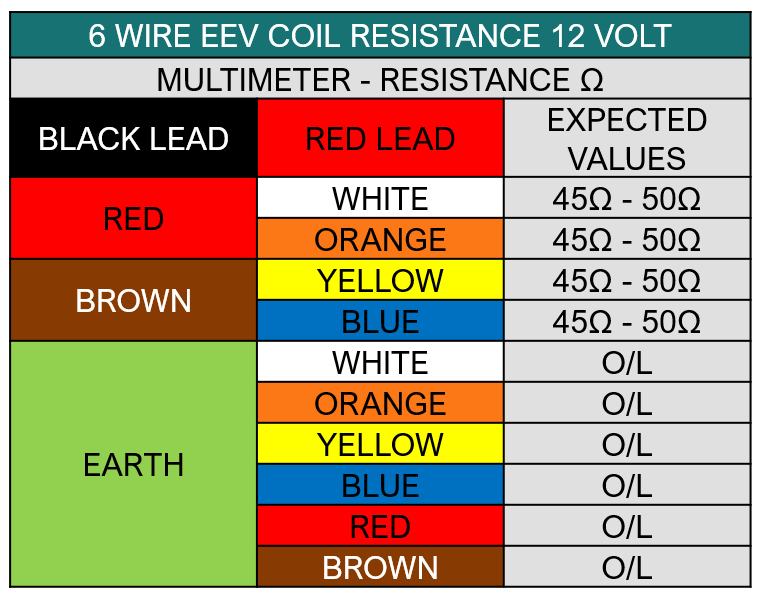
(b) 6-Wire Coil – 12 V Type
| Test Leads | Expected Reading (Ω) | Remarks |
|---|---|---|
| Red → White | 45 – 50 Ω | Normal range |
| Red → Orange | 45 – 50 Ω | Normal range |
| Brown → Yellow | 45 – 50 Ω | Normal range |
| Brown → Blue | 45 – 50 Ω | Normal range |
| Earth → All other leads | O/L | No continuity to ground |
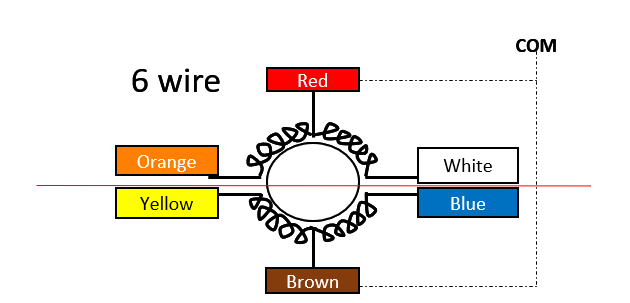
Coil identification: Red and Brown are common supply leads for two coil sets (4-phase stepper).
(c) J-Series High-Resistance Coil – 12 V Type
| Test Leads | Expected Reading (Ω) | Remarks |
|---|---|---|
| Red → White | 150 Ω | Standard phase resistance |
| Red → Orange | 150 Ω | Standard phase resistance |
| Brown → Yellow | 150 Ω | Standard phase resistance |
| Brown → Blue | 150 Ω | Standard phase resistance |
| Blue → Yellow | 300 Ω | Combined coil reading |
| Orange → White | 300 Ω | Combined coil reading |
| Earth → All other leads | O/L | No continuity to ground |
Step 4 – Evaluate Results
| Condition | Observation | Action |
|---|---|---|
| Normal | All readings within range | Coil OK |
| Open circuit | O/L between red and phase wires | Replace coil |
| Short circuit | < 40 Ω (low resistance) | Replace coil |
| Ground fault | Resistance between coil and earth | Replace coil and inspect wiring |
5. Understanding the Coil Configuration
5-Wire Configuration
- One common feed (Red) energizes four separate phases.
- Each phase winding is controlled sequentially to move the valve step-by-step.
(Refer to diagram: Red = COM; White/Orange/Yellow/Blue = Phases)
6-Wire Configuration
- Two common feeds (Red and Brown) control two paired phase sets.
- Provides higher torque and smoother motion, commonly used in large-capacity VRF systems.
(Refer to diagram: Red/Brown = COM; White/Orange/Yellow/Blue = Phases)
6. Common Faults and Causes
| Symptom | Likely Cause | Corrective Action |
|---|---|---|
| EEV not stepping / stuck open | Open circuit in one or more coil phases | Replace coil |
| Abnormal refrigerant pressures | Misalignment of coil on valve body | Refit coil correctly |
| Intermittent cooling / heating | Loose coil connector or oxidation | Clean and reseat terminals |
| EEV humming or clicking | Shorted or unbalanced coil winding | Replace coil |
| Error code (communication or stepper fault) | PCB driver failure or coil short | Check both PCB and EEV assembly |
7. Technician Tips
- Use insulated probes to avoid contact with adjacent pins.
- When testing installed, always confirm the coil is not powered — induced voltage may damage the multimeter.
- Do not megger test the coil; use standard resistance testing only.
- After reassembly, apply dielectric grease to terminals to prevent moisture-induced resistance drift.
8. Summary
- Standard EEV coils measure 45 – 50 Ω (12 V type) between common and phase wires.
- High-resistance J-Series coils measure 150 Ω per phase.
- All coils must read open (O/L) to earth.
- Visual inspection and correct physical mounting are essential to prevent operational faults.