
General Assist Technical Reference
Guidelines for Reuse of Existing Refrigerant Piping
Assessment requirements before connecting a replacement system to existing pipework
Based on Fujitsu General Limited Global Technical & Service Support Division guidance revised 24 June 2022.
Important notice: Fujitsu General does not guarantee products that use existing refrigerant piping. Existing pipework must only be considered for reuse after completing the checks below.
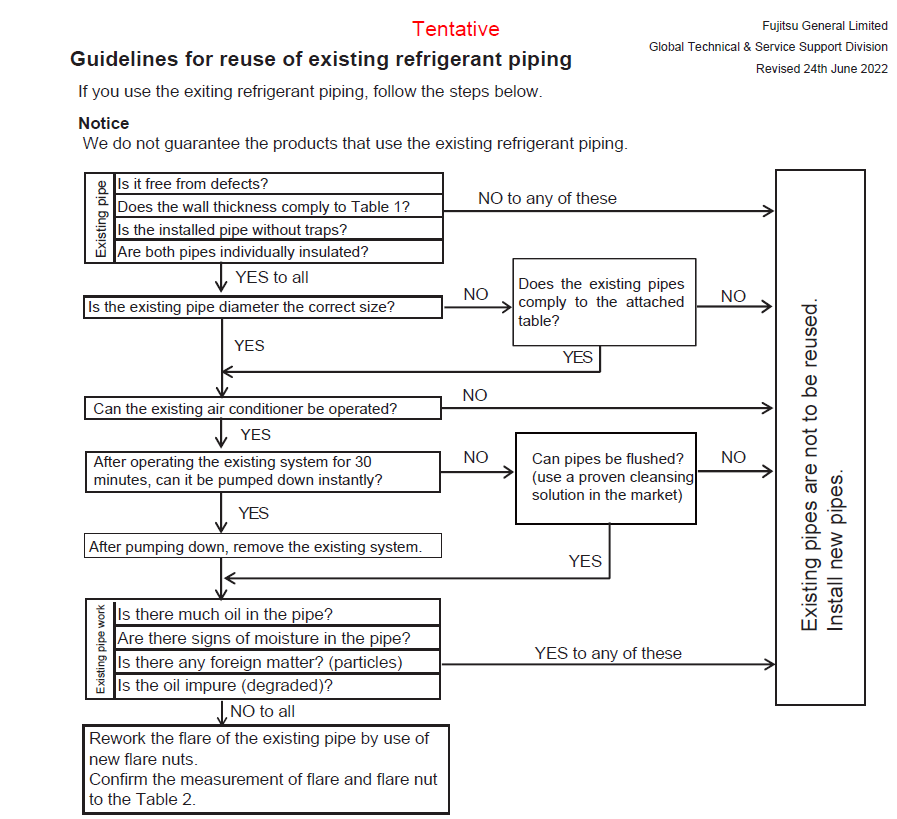
1. Reuse decision process
Existing refrigerant pipework may only proceed to reuse assessment when all initial checks are satisfactory. If any mandatory check fails and cannot be corrected by an approved method, install new refrigerant piping.
| Step | Check | Required action |
|---|---|---|
| 1 | Is the existing pipe free from defects? | If no, do not reuse the pipe. |
| 2 | Does the pipe wall thickness comply with Table 1? | If no, do not reuse the pipe. |
| 3 | Is the installed pipe free of traps? | If no, do not reuse the pipe. |
| 4 | Are both pipes individually insulated? | If no, do not reuse the pipe. |
| 5 | Is the existing pipe diameter correct? | If not, it may only proceed if the existing pipe sizes comply with the applicable pipe-size table for the replacement system. |
| 6 | Can the existing air conditioner be operated? | If no, do not reuse the pipe. |
| 7 | After operating the existing system for 30 minutes, can it be pumped down instantly? | If no, the pipe must be flushed using a proven commercially available cleaning solution. If flushing cannot be completed, install new pipework. |
| 8 | After pump-down and removal of the existing system, inspect the pipe internally. | If contamination or degraded oil is identified, do not reuse the pipe. |
| 9 | If all checks are satisfactory, rework the flare using new flare nuts. | Confirm flare and flare-nut dimensions against Table 2. |
2. Existing pipe requirements
- The pipe must be free from defects.
- Pipe wall thickness must meet the minimum requirements in Table 1.
- The installed piping must be free of traps.
- Liquid and gas pipes must be individually insulated.
- Pipe diameter must be suitable for the replacement system or comply with the applicable approved alternate pipe-size table.
Pipe suitability is not determined by diameter alone. Condition, wall thickness, installation quality, insulation and internal cleanliness must all be satisfactory.
3. Internal inspection after removal
After the existing system has been pumped down and removed, inspect the existing pipework for the following:
- Excessive oil remaining in the pipe.
- Signs of moisture.
- Foreign matter or particles.
- Degraded or impure oil.
Reject the existing pipework if any of the above conditions are found. New refrigerant piping is required.
4. Flare and flare-nut requirements
If the existing pipework passes all reuse checks:
- Cut off and rework the existing flare.
- Use new flare nuts.
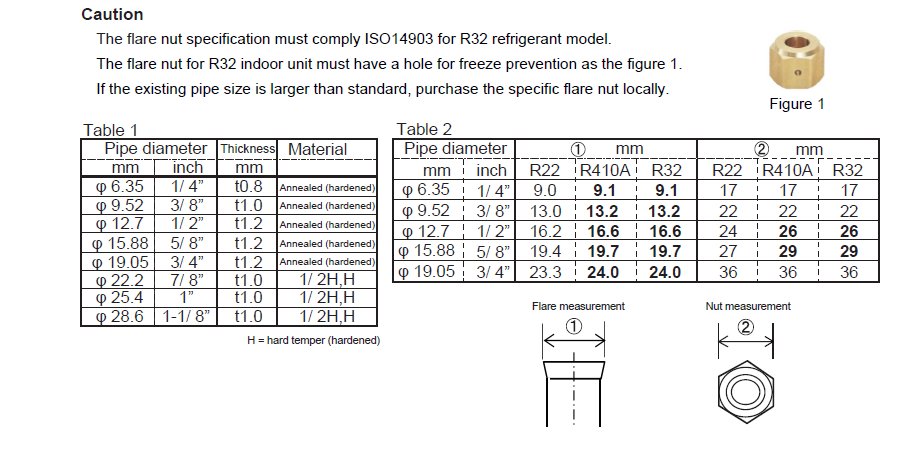
- Confirm the flare measurement and flare-nut measurement against Table 2.
- For R32 refrigerant models, the flare-nut specification must comply with ISO 14903.
- The flare nut used on an R32 indoor unit must include the freeze-prevention hole shown in the source guidance.
- If the existing pipe size is larger than the standard connection size, obtain the required flare nut locally.
5. Table 1 – minimum pipe wall thickness
| Pipe diameter | Imperial | Minimum thickness | Material |
|---|---|---|---|
| Ø 6.35 mm | 1/4 in | t0.8 mm | Annealed |
| Ø 9.52 mm | 3/8 in | t1.0 mm | Annealed |
| Ø 12.7 mm | 1/2 in | t1.2 mm | Annealed |
| Ø 15.88 mm | 5/8 in | t1.2 mm | Annealed |
| Ø 19.05 mm | 3/4 in | t1.2 mm | Annealed |
| Ø 22.2 mm | 7/8 in | t1.0 mm | 1/2H, H |
| Ø 25.4 mm | 1 in | t1.0 mm | 1/2H, H |
| Ø 28.6 mm | 1-1/8 in | t1.0 mm | 1/2H, H |
Material note: H = hard temper (hardened).
6. Table 2 – flare and flare-nut measurements
| Pipe diameter | Imperial | Flare measurement ① (mm) | Nut measurement ② (mm) | ||||
|---|---|---|---|---|---|---|---|
| R22 | R410A | R32 | R22 | R410A | R32 | ||
| Ø 6.35 mm | 1/4 in | 9.0 | 9.1 | 9.1 | 17 | 17 | 17 |
| Ø 9.52 mm | 3/8 in | 13.0 | 13.2 | 13.2 | 22 | 22 | 22 |
| Ø 12.7 mm | 1/2 in | 16.2 | 16.6 | 16.6 | 24 | 26 | 26 |
| Ø 15.88 mm | 5/8 in | 19.4 | 19.7 | 19.7 | 27 | 29 | 29 |
| Ø 19.05 mm | 3/4 in | 23.3 | 24.0 | 24.0 | 36 | 36 | 36 |
Summary: Reuse of existing refrigerant pipework is conditional. Confirm pipe condition, minimum wall thickness, installation arrangement, insulation, pipe sizing, ability to operate and pump down the old system, and internal cleanliness. Where all checks pass, reflare the pipe and use new compliant flare nuts before installing the replacement equipment.
Source: Fujitsu General Limited – Global Technical & Service Support Division, “Guidelines for reuse of existing refrigerant piping”, revised 24 June 2022. Source document marked “Tentative”.