
Defrost Symbol – What It Means
1. Why defrost mode happens
During heating operation, the outdoor unit absorbs heat from the outside air. In cold or humid weather, moisture can freeze on the outdoor heat exchanger. If this frost is allowed to build up, it can reduce airflow and heating performance.
The air conditioner therefore enters an automatic defrost cycle to melt and remove the frost before returning to normal heating.
| What may happen | What it means |
|---|---|
| The outdoor fan stops | This allows the system to warm the outdoor heat exchanger and clear the frost. |
| The indoor fan slows or stops | This helps prevent cool air from being circulated into the room during the cycle. |
| Heating pauses temporarily | Normal heating resumes automatically after defrost is complete. |
| Water or steam appears outside | Melting frost may drain from the outdoor unit, and vapour may be visible in cold weather. This can be normal. |
2. How long does defrost take?
A defrost cycle will commonly last several minutes. The exact duration and frequency depend on outdoor temperature, humidity, system load and the amount of frost on the outdoor heat exchanger.
In cold or humid conditions, defrost may occur more often. This is part of the system’s normal control process.
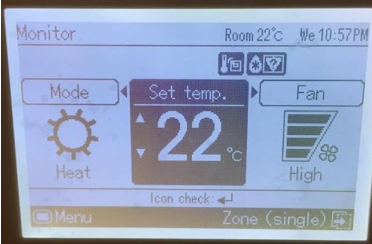
3. What you may see on the controller
The controller may display a defrost indicator while the system is temporarily clearing frost from the outdoor unit.
4. What you may notice in the room
- Warm airflow may stop for a short period.
- The room may feel slightly cooler while heating is paused.
- The indoor fan may remain stopped briefly after defrost while the heat exchanger warms up.
- Normal heating should then restart without any manual input.
5. When to contact your installer or service agent
Arrange further assessment when:
- the defrost indicator remains displayed for an unusually long period;
- the system does not return to heating operation;
- heating output remains poor after the cycle has finished;
- an error code is displayed; or
- the outdoor unit is heavily iced and does not appear to clear itself.
6. Summary
- Defrost is a normal part of heating operation.
- The outdoor unit temporarily melts frost from its heat exchanger.
- Heating and fan operation may pause for several minutes.
- The system should return to heating automatically.
- Further assessment is recommended if defrost does not finish or heating does not resume.
Support
Australia: 1300 364 484
New Zealand: +64 4 568 8761