AIRSTAGE Technical Reference
External Input / Output PCB
Model UTY-XCSXZ2 - connection, functions and installation notes
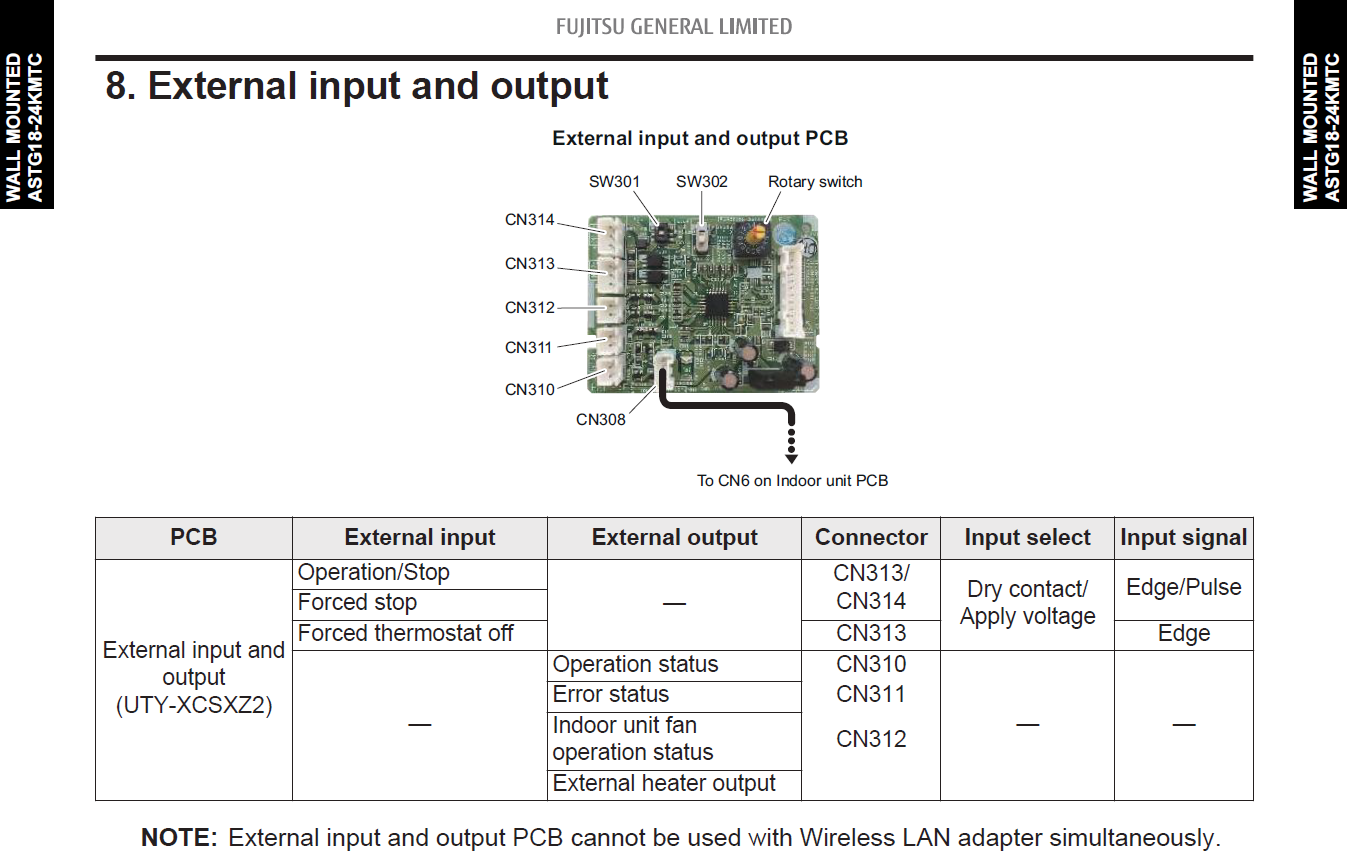
The external input/output PCB allows a compatible indoor unit to interface with an external control system, including a Building Management System (BMS) or third-party automation controller. It supports remote operation control and indoor-unit status monitoring through external signals.
Important: The external input/output PCB cannot be used at the same time as the Wireless LAN Adapter. Refer to the applicable D&T Manual and installation documentation for detailed configuration and compatibility requirements.
1. PCB connection overview
Connect the External Input and Output PCB to CN6 on the indoor unit main PCB.
| Component | Purpose |
|---|---|
| Rotary switch | Selects the required function. |
| SW301 / SW302 | DIP switches used for configuration. |
| CN308-CN314 | Connection ports for external input and output signals. |
2. Function description
External inputs
| Function | Description | Connector | Input type | Signal |
|---|---|---|---|---|
| Operation / Stop | Enables or disables unit operation remotely. | CN313 / CN314 | Dry contact / Voltage | Edge / Pulse |
| Forced Stop | Immediately stops operation regardless of the current mode. | CN313 | Edge | - |
| Forced Thermostat Off | Temporarily disables temperature control. | CN313 | Edge | - |
External outputs
| Function | Description | Connector |
|---|---|---|
| Operation Status | Outputs an indoor-unit operation signal. | CN310 |
| Error Status | Outputs a fault signal. | CN311 |
| Indoor Fan Status | Indicates the indoor fan operating condition. | CN312 |
| External Heater Output | Provides an ON/OFF output to an external heater. | CN312 |
3. Installation notes
- Do not connect both the Wireless LAN Adapter and the External I/O PCB at the same time.
- Confirm that the input voltage and contact type match the specifications in the applicable installation manual.
- Use shielded cable for signal wiring to reduce electrical interference.
- Confirm the rotary switch position and DIP-switch settings before applying power.
Before commissioning: Verify the indoor-unit model, accessory compatibility, connector allocation, voltage requirements and selected control function against the current installation and D&T manuals.