Overview
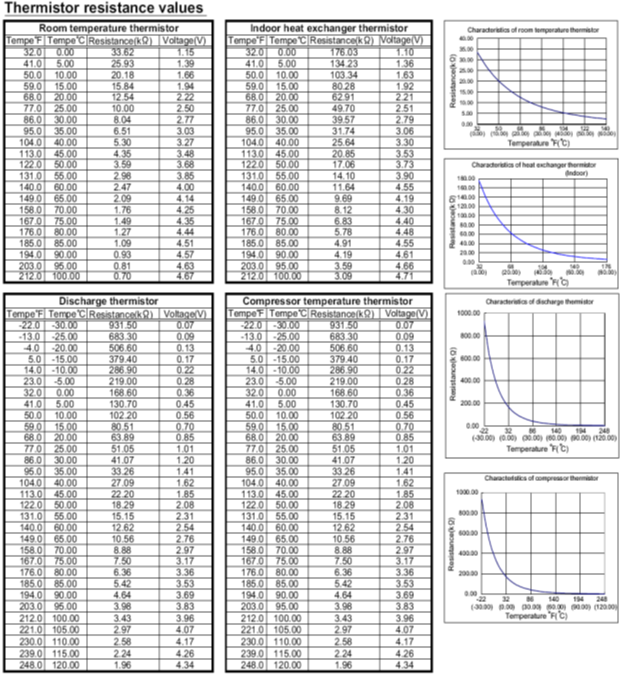
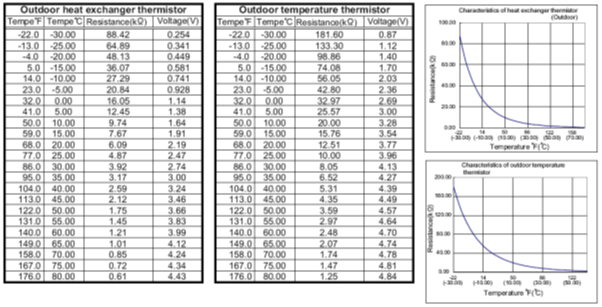
This reference provides the standard resistance and voltage values for Fujitsu General thermistors used in indoor and outdoor systems.
Thermistors are essential for accurate temperature sensing and system protection during heating and cooling operations.
Thermistor Types and Functions
| Thermistor | Function | Typical Location |
|---|---|---|
| Room Thermistor | Measures return air temperature. | Indoor PCB or return air sensor. |
| Indoor Heat Exchanger Thermistor | Monitors coil temperature for heat/cool mode changeover. | Attached to indoor coil. |
| Discharge Thermistor | Detects compressor discharge temperature to prevent overheating. | Mounted on compressor discharge pipe. |
| Compressor Thermistor | Monitors compressor shell or winding temperature. | Installed on compressor casing. |
Key Parameters
Resistance Range: ~130kΩ at –25°C to ~2.9kΩ at 100°C
Voltage Range: ~0.1V to 4.7V (depending on thermistor type and ambient condition)
Type: Negative Temperature Coefficient (NTC) thermistors — resistance decreases as temperature rises.
Testing Procedure
Power Off the Unit before testing.
Disconnect the thermistor from the circuit to ensure accurate readings.
Use a digital multimeter set to the resistance (Ω) range.
Compare the measured resistance against the reference table or temperature chart.
Replace thermistor if deviation exceeds ±10% of the specified value.
Reference Table Summary
| Temperature (°C) | Room Thermistor (kΩ) | Indoor HEX Thermistor (kΩ) | Discharge Thermistor (kΩ) | Compressor Thermistor (kΩ) |
|---|---|---|---|---|
| –25 | 683.3 | 683.3 | 683.3 | 683.3 |
| 0 | 219.0 | 219.0 | 219.0 | 219.0 |
| 25 | 41.1 | 39.6 | 37.3 | 37.3 |
| 50 | 10.3 | 10.3 | 10.1 | 10.1 |
| 75 | 4.7 | 4.2 | 4.1 | 4.1 |
| 100 | 2.4 | 2.3 | 2.2 | 2.2 |
Important Notes
All thermistor readings must be taken with the unit isolated from power.
Voltage readings can be taken in-circuit between signal and ground points for operational diagnosis.
Abnormal resistance indicates possible sensor degradation, poor contact, or PCB fault.
Graphs provided show the inverse relationship between resistance and temperature for each thermistor type.